WCF World Championships
by Tony Hall
Posted March 23, 2004
WCF Rules of Golf Croquet
2004 RevisionPreface
The Rules published below have been drawn up by the WCF Golf Croquet Rules Committee, assisted by a number of others who have commented as requested. They will be used at the MGM Assurance 6th WCF World Golf Croquet Championships to be held in England in June 2004. These Rules are published for general information and for use by interested parties.
The major changes to the December 1998 revision are that the winner of the toss will decide which balls to play with; that it will be the opponent of the owner of a ball over the halfway line who will decide where the ball will be moved to; and after a striking fault the opponent will decide whether the balls are replaced or not. Most of the revision has been to make the wording easier to understand. Some Rules have been moved and arranged more logically. There have been additions to make some Rules explicit rather than implied. The Diagrams are the same as for the 1998 revision.
These Rules will be considered again in the light of experience gained at the World Championships in June and any necessary corrections will be made after that event.
Comments are welcome and should be made to the WCF Golf Croquet Rules Committee or to Tony Hall, Chairman.
THE WCF RULES OF GOLF CROQUET
March 2004 Revision
1. Outline of the Game
(a) The game is played as either doubles with four players or singles with two players. In doubles one side of two players plays with blue and black balls and the other side with red and yellow, each player playing only one colour. In singles each player plays both balls of their side.
(b) The object of the game is for each side to cause either ball of its side to run hoops in a specified order. A point is scored for the side whose ball first runs the hoop in order in accordance with Rule 7. The winner is the side which scores more points.
(c) A match is a contest for the best of either 1, 3 or 5 games of 7, 13 or 19 points. Each game ends as soon as one side (the winner) has scored a majority of the points to be played.
(d) The hoops are contested as shown in Diagram 1. In a 7 point game the first 7 hoops are played. In a 13 point game the first 12 hoops are played and the final point is scored by contesting hoop 3 again. In a 19 point game the first 12 hoops are played, then hoops 3, 4, 1, 2, 11 and 12. The final point is scored by contesting hoop 3 again.
(e) The game is played by striking a ball with a mallet. The player whose turn it is to play is known as the striker. The striker shall not strike a partner's or an opponent's ball (see Rule 13(a)(16) and (17)).
(f) There are four balls usually coloured blue, red, black, yellow. They are always played in that sequence. Thus if yellow is played in one stroke, blue will be played in the following stroke.
(g) All the balls are always for the same hoop. When that hoop point has been scored by any ball, all balls are then for the next hoop in order.
(h) If a player or the referee believes that an error has been committed, they shall immediately announce the fact so that the matter may be investigated and, if necessary, corrected. By so doing, they are said to forestall play.
(i) Two games may be played simultaneously on the same court, normally using alternative coloured balls or striped balls. If this is done all players should be aware of the other game and try to avoid any conflicts. Balls from the other game may be marked with permission from the participants of that game. Interference between balls in different games is dealt with by Rule 10.
2. The Standard Court
(a) The court is a rectangle, measuring 35 by 28 yards (32 by 25.6 metres). Its boundaries shall be marked clearly, the inner edge of the definitive border being the actual boundary. Diagram 1 shows the setting. The corners are known as corners I, II, III, and IV and the boundaries as south, west, north and east, regardless of the actual orientation of the court. The peg is set in the centre of the court. The hoops are set parallel to the north and south boundaries, the centres of the two inner hoops are 7 yards (6.4 metres) to the north and south of the peg and the centres of the four outer hoops are 7 yards (6.4 metres) from the adjacent boundaries.
(b) If there is insufficient space for a full size court a smaller court may be laid out. Its dimensions should be kept in the same proportions as the standard court.
(c) For various reasons it may be desirable to vary the court layout slightly. See Rule 15(a)(3) and (4). If this is done the peg shall remain on the line between hoops 5 and 6.
3. Equipment
(a) The hoops shall be of round metal of uniform diameter of 5/8 inch (16 mm) above the ground. They shall be 12 inches (300 mm) in height above the ground measured to the top of the crown, vertical and firmly fixed (but see (e) below). The crown shall be round or square in section and shall be straight and at right angles to the uprights, whose inner surfaces shall be parallel and not less than 3 11/16 inches (93.5 mm) or more than 4 inches (100 mm) apart. All hoops on any court shall be the same dimensions to a tolerance of 1/32 inch (0.8 mm). The hoops shall be white, with the crown of the first hoop blue. The crown of the last hoop may be red.
(b) The peg shall have a uniform diameter of 1 1/2 inches (38 mm) and a height of 18 inches (450 mm) above ground. It shall be vertical and firmly fixed in the ground. It shall be white to a height of 6 inches (150 mm) above the ground with blue, red, black and yellow bands descending in that order from the top.
(c) The four balls are usually coloured blue, red, black and yellow, but alternative colours or stripes are permitted. Balls shall be 3 5/8 inches (92 mm) plus or minus 1/32 inch (0.8 mm) diameter, with a milled surface and weight of 16 ounces (454 grams), plus or minus 1/4 ounce (7 grams). Balls shall be approved by the country of play or, in the case of WCF events, by the WCF. Faulty or damaged balls may be changed at any time during a game. Where several courts are in use the balls shall be used in matched sets.
(d) The head of a mallet may be of any material provided the player gains no playing advantage over wood. The end-faces shall be parallel and shall have identical playing characteristics. Bevelled edges are not part of the end-faces.
(e) The dimensions given in Rule 3(a), (b), (c), and (d) above may vary slightly (see Rule 15(a)(3) and (4)), but the crown of a hoop shall not be less than 11 1/2 inches (287 mm) from the ground.
4. Accessories
The following accessories may be supplied for guidance, convenience and decoration. Any accessory impeding a player may be removed temporarily.
(a) Corner flags coloured blue, red, black and yellow may be placed in corners I, II, III and IV respectively. They shall be mounted on posts about 12 inches (300 mm) high, either up to 12 inches (300 mm) outside the court, or touching the boundary but not intruding into the court.
(b) A check fence high enough to arrest the progress of balls may be placed around the boundary and about 1 1/2 yards (1.3 metres) outside it.
(c) White pegs, either 3/4 inch (20 mm) in diameter and 3 inches (80 mm) in height or sufficiently prominent to be seen, may be placed on or up to 12 inches (300 mm) outside the boundary to mark the ends of the halfway lines.
(d) Clips. Two sets of six clips may be provided to record the scoring of hoops. One set is to be red or yellow and the other blue or black (or other colours if alternative balls are used). The appropriate colour clip may be placed on a hoop by the side scoring that hoop.
(e) Sequence post. Where alternative colours are used regularly, a post displaying their colour sequence may be located just off the court, or the peg may be modified to show all colours.
5. The Start
(a) The side which wins the toss may choose to play blue and black or red and yellow. Subject to Rule 5(c), Blue is played first.
(b) All balls are initially played from a position on the court within a yard (900 mm) of corner IV.
(c) When a match consists of more than one game, the players retain the same balls, and the loser starts the next game with the loser’s next ball in sequence.
6. The Turn
(a) Each turn consists of a single stroke. A stroke is played when the striker strikes the striker's ball with a mallet. The accidental touching of a ball with the mallet by the striker while preparing to play a stroke is a stroke (or a fault) and the turn ends.
(b) A player may not deem a stroke to have been played and an attempt to strike a ball which fails to touch it (an "air swing") is not a stroke or a fault and the player remains entitled to play.
(c) A ball may be jumped over a hoop or another ball subject to Rule 13(a)(14) (court damage).
(d) As a result of a stroke the striker's ball may run a hoop in order and score a point, or points if two hoops are run in order, or may cause other balls to move and score a point.
(e) When the balls have stopped, each ball off the court is placed so that its centre is on the boundary where it left the court. A ball is off the court if more than half the ball crosses the boundary.
(f) If such a ball cannot be so placed because of the presence of another ball, it shall be placed after the other ball has been played. If the ball to be placed will be played before the other ball, it is placed on the boundary in contact with the other ball as near as possible to where it left the court.
(g) If a ball placed on the boundary obstructs the playing of another ball, it is temporarily removed.
(h) If a ball moves after its position has been agreed, it shall be returned to the agreed position. The position of the ball is agreed if the next player has played or if a referee has ruled on the position of the ball.
7. Scoring a Point
(a) A ball scores a point by passing through the correct hoop in the order and direction shown in Diagram 1. This is known as running a hoop. If a ball first enters its hoop in order in the direction opposite to that shown in Diagram 1, it cannot score the point for itself in the same stroke. If it has so entered, it cannot score the point in a subsequent stroke unless it stops in a position either entirely on the playing side or partially within the uprights of the hoop so that it does not break the plane of the non-playing side.
(b) Running a hoop is illustrated in Diagram 2. The ball starts to run a hoop as soon as the front of the ball breaks the plane of the non-playing side of the hoop. It completes the running if it stops clear of the plane of the playing side.
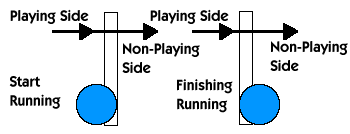
(c) A ball may run a hoop in one or more turns.
(d) If the striker's ball causes another ball to run the hoop being contested, that other ball is said to be peeled and scores the point, even if the striker’s ball also runs the hoop in the same stroke. If two balls are peeled in one stroke, the ball nearest the hoop before the stroke scores the point.
8. Advice
(a) In doubles play, players may advise their partners and assist in the playing of a stroke by indicating the direction in which the mallet should be swung. However, when the stroke is actually played, the partner shall stand well clear of the striker or any position which might assist the striker in gauging the strength or direction of the stroke.
(b) If asked, a player shall tell an opponent the score, which hoop is next in order, which ball shall play, how any ball over the halfway line reached its position, and whether a ball has been replaced on court after crossing the boundary or on a penalty spot.
9. Interference
(a) Loose impediments on the court may be removed. Examples include worm casts, twigs, leaves, nuts, refuse and similar material.
(b) The striker may ask the referee to give relief from a hole on the court that affects play. The hole shall be repaired if possible. If this is impractical the referee may move the ball so as to give the striker no advantage. No relief shall be given from an imperfection in the surface which is a normal feature of that particular court.
(c) Where a fixed obstacle outside the court interferes with a striker's swing or where the ground levels outside the boundary prevent the striker from adopting a level stance, the striker may, with the consent of the opponent or referee, move the ball to a point on the line connecting the point where the ball lay and the striker's intended target. The ball may be moved only the minimum distance to avoid the obstruction or uneven ground. If other balls lie within a yard (900 mm) of the striker's ball and are likely to interfere with the passage of the striker’s ball, they shall be moved an equivalent distance into the court, parallel to the line of play, before the stroke is taken, so that their relative positions remain the same. If such balls are not disturbed by the striker’s ball, they shall be replaced immediately.
(d) An outside agency is any agency unconnected with the game. Examples include animals, spectators, a referee other than the players, the players or equipment from another game, a ball off the court and other stray objects. Neither loose impediments nor weather are outside agencies.
(e) If a non-striking fault or an outside agency moves a stationary ball, it is replaced immediately.
(f) If a non-striking fault or an outside agency interferes with a moving ball during a stroke and materially affects the outcome of the stroke, any balls moved by the stroke shall be replaced and the stroke shall be replayed. If the outcome of the stroke is not materially affected, the referee shall place the ball that suffered interference where it would otherwise have stopped.
(g) After interference a moving ball cannot cause a stationary ball to move or score a point and any such ball shall be replaced.
10. Playing out of Sequence
(a) If a player or the referee sees a player about to play out of sequence they shall forestall play immediately.
(b) If a ball is played out of sequence by its owner and play is forestalled before four further turns have been played, the balls are replaced without penalty, no points are scored in the turns in error and the correct ball is then played. Otherwise there is no remedy and play continues as if the error had not been committed.
(c) If balls are replaced, the referee’s ruling on their positions is final but help may be sought from the players and, if agreed by the players, from spectators.
11. The Halfway Rule
- (a)
- (1) At the end of a stroke in which a hoop point has been
scored,
any ball (other than the ball that scored the hoop point) which is
resting beyond the halfway line between the hoop scored and the next
hoop in order (see Rule 11(d)) is a "relevant ball" for the purposes of
this Rule.
- (2) A relevant ball shall be moved in accordance with Rule
11(b) before the next stroke is played unless Rule 11(c) applies.
- (3) If the side which owns a relevant ball plays a stroke before it has been so moved and the opposing side or referee forestalls play before the opposing side has played a stroke, then the opposing side may choose to have the stroke in error cancelled and any balls moved replaced so that Rule 11(a)(2) may be applied.

- (i) contact with an opponent's ball, or
- (ii) an opponent's stroke, or
- (iii) peeling the ball that scored the hoop point, or
- (iv) being hit by its partner ball which scored the hoop point in the same stroke.
- (i) plays a stroke before it has been moved; or
- (ii) announces before it has been moved that it shall be played from where it lies.
- (a) Subject to Rule 12(b), a non-striking fault is
committed
at any time if a player touches or is touched by any ball, whether at
rest
or in motion, or moves or shakes a ball at rest, with any part of the
body, clothes or mallet either directly or by hitting a hoop or the
peg.
- (b) A non-striking fault is not committed if:
- (1) the striker touches the striker’s ball with the mallet when playing a stroke, whether in or out of sequence.
- (2) any player touches a ball when:
- (i) replacing it on the boundary; or
- (ii) moving a ball under Rule 9(b) or (c); or
- (iii) moving a ball under Rule 11(b); or
- (iv) marking or cleaning a ball with the permission of the opponent or referee.
- (c) If a non-striking fault is committed, play continues in accordance with Rule 9(e) or (f) and the side which committed the fault loses its next turn.
13. Striking Faults
- (a) A striking fault may only be committed from the time
the striker’s ball is struck by the mallet until the striker leaves
their stance
under control. It is a fault if, in striking, the striker:
- (1) touches the head of the mallet with a hand;
- (2) rests the shaft of the mallet or a hand or arm on the
ground
or an outside agency;
- (3) rests the shaft of the mallet or a hand or arm
directly connected with the stroke against any part of the legs or
feet;
- (4) plays before any ball moved in the previous stroke
stops
or before all balls are replaced on the court, unless directed by the
referee or with the prior agreement of the opponent;
- (5) causes the mallet to strike the striker’s ball by
kicking, hitting, dropping or throwing the mallet;
- (6) strikes the striker's ball with any part of the mallet
other than an end-face (see Rule 3(d)), either
- (i) deliberately; or
- (ii) accidentally in a stroke which requires special care because of the proximity of a hoop or the peg or another ball;
- (7) maintains contact between the mallet and the striker’s
ball for an appreciable period when the striker’s ball is not in
contact
with any other ball or after the striker’s ball has hit another ball;
- (8) "double taps" the striker’s ball by striking it more
than
once in the same stroke or allows the striker’s ball to retouch the
mallet;
- (9) strikes the striker's ball so as to cause it to touch
a
hoop upright or the peg when in contact with the mallet;
- (10) strikes the striker's ball when it lies in contact
with
a hoop upright or the peg otherwise than in a direction away therefrom;
- (11) subject to Rule 10, touches a ball other than the
striker's
ball with the mallet;
- (12) touches any ball with any part of the body or
clothes;
- (13) deliberately causes the striker’s ball to hit a ball
on
a penalty spot or that was replaced after going off the court;
- (14) deliberately plays a stroke in a manner in which the
mallet is likely to and does cause substantial damage to the court
(Substantial damage
is damage capable of affecting a subsequent stroke played over the
damaged
area, normally involving breaking of the surface of the court.);
- (15) strikes an opponent’s ball;
- (16) in doubles, strikes the partner’s ball.
- (b) An "air swing" (see Rule 6(b)) is not a stroke or a
fault
and the striker remains entitled to play.
- (c) Action after a striking fault
- (1) Subject to Rule 16(f), the opponent chooses whether
the
balls remain where they lie after the stroke or are replaced in the
positions they occupied before the fault was committed. In either case
no point is scored for any ball and the turn ends.
- (2) Except for Rule 13(a)(15), if neither the opponent nor
the referee forestalls until after the next player has played, there is
no remedy and play continues as if the fault had not been committed.
- (3) If a fault under Rule 13(a)(15) is announced before four further turns have been played, all balls are replaced in the positions they occupied before the fault was committed, no points are scored and the opponent then plays. Otherwise there is no remedy and play continues with the correct balls in the proper sequence as if the fault had not been committed. The referee's ruling is final, but help in reconstructing the correct situation may be sought from the players and, if agreed by the players, from spectators.
14. Behaviour
If a player behaves in any of the following ways the referee shall warn them not to do so again. If the behaviour is repeated the referee may raise a yellow card and the next player in the offending side loses their turn. If the behaviour is repeated a second time the referee may raise a red card and the offending side loses the match. In this case the score is recorded as the winning total (usually 7) to the winner and the score already recorded by the loser when the red card is raised.
- (a) Fails to observe the required standard of dress.
- (b) Leaves the court without good reason. Any absence with
good reason should be for not more than five minutes.
- (c) Acts on tactical advice from anyone other than their
partner.
- (d) Smokes during a game or consumes alcohol during a
match.
- (e) Disturbs other players during the match.
- (f) Interrupts the striker by standing or moving in front
of
the striker or otherwise.
- (g) Bargains with, argues with or is aggressive with an
opponent.
- (h) Fails to play with reasonable dispatch. Players shall
not waste time.
- (i) Uses a mark or marker to assist the striker in gauging
the strength or direction of a stroke.
- (j) Except in the absence of a referee, attempts to
perform
a test to determine whether a point has been scored.
- (k) Provides wrong advice to an opponent when asked to
provide advice in accordance with Rule 8(b).
- (l) Continues to damage the court by committing faults
under Rule 13(a)(14). The second fault of this type will be considered
to be the first instance of unacceptable behaviour.
- (m) Fails to accept a decision of the referee on a matter
of fact or shows lack of respect for the referee.
- (n) Acts in such a manner that may bring the game into disrepute.
15. Referees
- (a) The duties of the referee are to:
- (1) resolve disputes between players by applying the Rules
and by making rulings on matters of fact. If a situation is not covered
by
the Rules the dispute shall be decided so that the decision is equally
fair
to both sides in the best judgement of the referee. If this occurs the
facts shall be reported to the appropriate national association for
reference to the WCF.
- (2) when asked, explain the relevant Rules briefly, inform
players whether an error has been made, the score, which hoop is next
in
order, which ball shall play and whether a ball has been replaced on
court
after crossing the boundary or on a penalty spot. A player shall not be
given advice on tactics or technique.
- (3) check the condition of the court, the provision and
condition
of equipment and the accuracy of court settings and equipment. Ensure
that they are maintained as required during the match, including that
the hoops are the correct dimensions and tightly fixed in the ground
and that any holes
and scars in the court surface are repaired.
- (4) determine whether or not the court and its equipment
are sufficiently close to the specified dimensions as to be fit for
play.
- (5) direct any ball boys, ball girls and scorers appointed
to the game.
- (6) report to the Tournament Manager if a spectator is
giving
advice to a player or disturbing the match.
- (7) decide, using discretion and in consultation with the
Tournament Manager, whether a player more than 15 minutes late shall
forfeit the match.
- (8) enforce the rules of behaviour listed in Rule 14.
- (9) penalise bad behaviour without hesitation after one
warning.
- (10) forestall any player about to play out of sequence
(see
Rule 10).
- (11) observe and judge the fairness or effect of all
strokes.
- (12) determine whether any ball has scored a point or is
in
a position to do so. If a point has been scored, indicate this to
players, spectators and scorer by raising one arm above the head and by
calling the score.
- (13) after each hoop is scored, ensure that the provisions
of Rule 11 (The Halfway Rule) are applied.
- (14) lift and clean or permit a player to lift and clean
any
ball on request from the striker or on the referee’s initiative, or
decide
that it shall not be moved because its precise position is important.
- (15) move any balls (if a hole cannot be repaired or if a
swing
is obstructed) or decide they may not be moved (see Rules 9(b) and
(c)).
- (16) decide, using discretion and in consultation with the
Tournament Manager, to suspend or abandon a match. Suspension should
normally
be done immediately after a point is scored. After suspending a match,
the
referee shall mark the positions of the balls and record the score,
which
ball is next to play and any other information relevant to the game.
- (17) complete a scorecard or undertake other actions
required
by the Tournament Manager to ensure accurate recording of the results.
- (b) A player may appeal against a referee’s interpretation
of the rules but may not appeal against a referee’s ruling on a matter
of
fact. Appeals shall be made to the Tournament Referee.
- (c) In the absence of a referee the players are joint
referees. Players are not to gain an advantage by neglecting their
duties as joint referees. Players shall warn the other side before
playing hard shots. Both sides
are responsible for keeping the score, the striker announcing it after
each
point is scored. If there is a difference of opinion on a matter of
fact,
the opinion of the player with the best view is to be preferred. If two
views are equal, the striker’s opinion prevails.
- (d) If there is a need for a referee but none has been appointed, the following types of appointment may be made from referees officiating at a competition:
- (i) To intervene to ensure that play is lawfully continued after an error is claimed or admitted.
- (ii) To intervene if a player is heard giving erroneous information on the rules to their opponent.
- (iii) To volunteer relevant information to a Referee on Appeal.
- (iv) To apply to the Tournament Referee to be appointed to a game.
16. Handicaps
- (a) Handicap games may be played to allow players of
different abilities to compete so that they will have more equal
chances of success. Normal rules apply except as indicated in this
Rule. Each player is allotted
a handicap according to ability, ranging from zero for the strongest
players
up to 10 for the weakest players (for 13 point games).
- (b) In singles the weaker player is allowed a number of
extra
turns equal to the difference between the players’ handicaps.
- (c) In doubles extra turns are given to a player not a
side. The number given by the lower-handicapped player in one side to
the lower-handicapped
player in the other side is the difference between their handicaps
divided
by two but rounded up to the next whole number. The same procedure
applies
to the higher-handicapped players in each side.
- (d) No point shall be scored for the striker’s side in an
extra turn.
- (e) An extra turn may only be played by a striker at the
end
of that striker’s turn and shall be played with the same ball. A
striker
may play an extra turn at any stage in the game, and, if receiving more
than
one, play extra turns in succession.
- (f) At the conclusion of a turn the striker shall give a
clear indication of an intention to play an extra turn and forestall
the opponents
from playing. A striker who is entitled to play an extra turn and
indicates
an intention to do so may revoke that decision at any time before
playing
the stroke, unless the balls have been replaced after a striking fault
in
accordance with Rule 13(c)(1). The player’s intention not to play the
extra
turn shall be indicated clearly. However, a striker who has indicated
that
an extra turn will not be played shall not change that intention. When
a
striker decides to play an extra turn after committing a striking
fault,
Rule 13(c)(1) does not apply and the balls are replaced in the
positions
they occupied before the fault was committed.
- (g) Reserved. (This paragraph will describe how handicaps are set and changed, based on a player’s success in competition. Further consideration is being given to the content.)
REGULATIONS
1. Officials
Every tournament shall have a Tournament Manager (“TM”) and a Tournament Referee (“TR”) who are together responsible, as explained below, for the application and enforcement of the Rules and Regulations and the administration of the tournament. One person may perform both functions.
2. Referees, Ball Boys/Girls and Scorers
(a) The TR appoints referees to matches and supervises referees’ performance. A Deputy Tournament Referee shall be appointed by the TR to carry out the duties in the absence of the TR. A player may appeal to the TR on the interpretation of the Rules but not on matters of fact.
(b) Where possible, a referee shall be appointed to every match. The duties of a referee are specified in Rule 15.
(c) Where possible, one or two ball boys or girls shall be appointed to each match. They shall comply with the referee’s directions.
(d) A scorer or scorers may be appointed to a match.
3. Tournament Manager
The duties of the Tournament Manager are to manage the tournament in all respects to ensure it is enjoyable for spectators, players, officials and all others involved. Among other things the manager should:
(a) advertise and publicise the existence of the tournament, conditions and method of entering in order to ensure there is a good field and many spectators.
(b) receive entries, arrange the draw, time and order of play, allot courts to games and publish details in a programme and otherwise.
(c) arrange for all necessary courts, facilities, equipment and officials to be available.
(d) ensure appropriate accommodation and catering arrangements are made.
(e) make any alterations to the programme, draw and other arrangements as are necessary.
(f) grant or refuse leave of absence to competitors and officials.
(g) endeavour to ensure fair competition.
(h) supervise the standard of dress and off-court behaviour of players and officials at the tournament venue.
(i) if necessary, disqualify a player.
(j) ensure adequate publicity is given to the progress and results of the tournament.
(k) ensure prizes, if available, are presented at an appropriate ceremony.
(l) act as a tournament handicapper by giving a provisional handicap to any competitor who has no handicap, by altering handicaps as necessary before or during play and by giving new handicaps in place of provisional handicaps after play and informing players accordingly.
4. Handicaps
(a) In handicap events, players shall advise the TM of their correct handicaps on arrival.
(b) A player who plays at a handicap higher than their correct handicap shall be disqualified.
5. Time Limits
The TM may impose time limits as necessary. A time limit of less than an hour for a 13-point game shall be imposed only under exceptional circumstances. At the expiry of the time limit the game will continue until the next point is scored unless notified otherwise before the event. If a result is required the manager may authorise the continuation of the game for one more point.
6. Appeals Committee
(a) An Appeals Committee shall be established by the organising body before the tournament commences, comprising two representatives of the organising body and the TR. If any player has a grievance that cannot be settled by the TM, the matter shall be settled by the Appeals Committee whose decision will be final.
(b) The TM shall consult the Appeals Committee in respect of any change proposed to the advertised format of the tournament, but having consulted the committee, the TM retains the right to implement any changes he or she deems necessary to complete the tournament on time.
(c) The Appeals Committee shall make itself available at all times to the TM to give advice on the conduct of the tournament if such advice is requested.